
How to Search Civil Dockets
Pull the court name off a complaint, summons, notice, or earlier order before anything else. Small claims, FED evictions, and protection orders sit in Summit County Court. Civil claims under $25,000 do too. District Court takes the higher-value suits plus domestic-relations, probate, mental-health, and similar classes. One clerk, the Summit Combined Courts at the Justice Center, serves both courts. Yet the level and class lines stay distinct on any Summit County civil docket. For a date or setting, the Colorado Judicial Branch daily docket works best. CoCourts sells broader statewide index data. The clerk's Register of Action, or ROA, gives the fullest chronology. Work through these steps:
- Confirm the Summit County court level and collect the party name or known case number.
- Check the daily docket for a hearing date and Summit County location.
- Use CoCourts/LexisNexis for broader electronic case data, subject to its current terms and fees.
- Submit the official record form for the Summit County ROA, judgment, or a named filing.
- Call or visit the Summit County clerk when a case is old, protected, municipal, or absent online.
Summit County Civil Jurisdiction Divide
The $25,000 County Court ceiling is the most useful routing fact. Claims below it, along with small claims and FED cases, belong in Summit County Court. Anything above ordinarily starts in Summit County District Court. Both courts share one building. So a search by place alone can hide that legal split. Read the court level and case class on the docket. Do not stop at "Summit County Justice Center."
Quick answer: A single clerk counter serves both trial courts, but it does not merge their Summit County civil dockets.
Domestic relations, probate, and mental-health matters sit on the District Court side of the divide in Summit County. Protected filings within those cases may still carry access limits.
What a Civil Docket Shows
Think of a Summit County civil ROA as a chronology. It is not a folder of instant downloads. The ROA ties the case identity to events: service, answers, motions, settings, minute orders, judgments, and later enforcement work. An entry may name a document you cannot view remotely. When that happens, request the paper by its title and docket date.
| Case number and class | A year, class such as C, CV, or S, and a sequence in the Summit County court system. |
|---|---|
| Court and status | Summit County Court or Summit County District Court, assigned division, filed date, and current case status. |
| Caption and roles | Plaintiff and defendant, or petitioner and respondent, with counsel when public. |
| Case activity | Summit County complaint, service, answer, motions, notices, minute orders, and continuances. |
| Settings | Summit County return, status, motion, bench-trial, or jury-trial dates and their reset trail. |
| Outcome | Judgment, default, dismissal, stipulation, satisfaction, or appeal entries. |
| Post-judgment | Transcript of judgment, writ or garnishment filings, costs, and public balances. |
Summit County Civil Case Codes
Colorado's record request form offers C, CV, and S as the civil choices. Those labels help the clerk route a Summit County civil docket request. The form also shows 2023AA123456 as a sample structure. That sample does not mean every local case uses "AA." Never rebuild a number from memory or guess a missing class. Class codes vary.
- C
- A civil class shown on the statewide request form.
- CV
- A civil class used to identify the Summit County court file and request type.
- S
- The form's small-claims class choice.
- ROA
- Register of Action, the Summit County clerk's brief case history with minute orders and key events.
A known Summit County case number is your strongest identifier. Without one, the current clerk fee schedule allows a $5 name search.
Types of Civil Cases on the Docket
Civil dockets in Summit County hold more than one kind of dispute. The court level and class tell you where each matter belongs. A public filing can still contain protected exhibits, so expect limits even on open cases.
| Civil matter | Likely Summit forum | Docket clue |
|---|---|---|
| Small claims | Summit County Court | S class or small-claims identification |
| Civil claim below $25,000 | Summit County Court | County Court line and civil class |
| FED or eviction | Summit County Court | Case type and return or hearing events |
| Higher-value civil claim | Summit County District Court | District Court line and civil class |
| Domestic relations or probate | Summit County District Court | Distinct class, roles, and access limits |
Summit County Civil ROA Timeline
A typical civil chronology reads: Complaint or petition filed → case assignment → summons and service → answer or default request → motions and responses → status, motion, or trial settings → order or judgment → costs → satisfaction, enforcement, or appeal. Not every Summit County civil docket contains every step. A case can settle, be dismissed, or take a different procedural route.
Read the order itself before guessing why something ended. A dismissal might be voluntary, procedural, or on the merits. A default request alone does not prove judgment entered. A satisfaction entry on a Summit County docket records that a judgment obligation was satisfied, and it does not erase the case history before it.
Settings and Hearings on Civil Dockets
Civil returns post on any weekday at 4:00 p.m. through Summit Combined Courts. Beyond returns, a Summit County civil docket may list a status conference, motions hearing, bench trial, jury trial, protection-order hearing, or review. Entries usually carry the date, time, location, courtroom, judicial officer, case number, caption, and a short event description. When sources clash, the written notice or signed order controls. A reset can leave the old event in the ROA while adding the later date, so compare the newest entry against the latest signed order. For a date-focused approach, use the Summit County court calendar, then call the clerk if the event is close or the sources disagree.
Summit County Civil Return Time
That 4 p.m. civil-return setting carries practical weight in Summit County. It is not a promise that every civil hearing happens then. So read the event type and the notice. Watch the clerk counter too. It closes from 4 to 5 p.m. on the first and third Thursday for staff meetings, even though the building stays open later. If a return and a counter task land on the same afternoon, confirm the process before you travel. Calling 970-453-2272 beats betting on a late counter visit. Note: a civil return is a scheduled court event. A counter visit is a separate records task.
Summit County Civil Judgment Terms
Outcome labels on a Summit County civil docket can look alike. They name very different acts. A judgment is the court's enforceable ruling. A default judgment follows a failure to respond or appear under the governing process. A stipulated result reflects an agreement the court accepted or recorded. Dismissal ends the case without the requested adjudication. The order itself must be read for its reason.
- Satisfaction
- An entry that marks the judgment obligation as satisfied.
- Transcript of judgment
- A $25 clerk instrument used to record or enforce a judgment, not a verbatim hearing transcript.
- Minute order
- A short docket entry recording what the court did at a proceeding.
- Appeal
- The start of review in a higher court, not a new trial entry in the same docket.
Summit County Civil Record Requests
Need a specific document from a Summit County civil case? The Colorado Record/Document Request Form covers civil ROAs, Orders for Judgment, Transcripts of Judgment, Satisfactions of Judgment, Protection Orders, and other named filings. Probate records work the same way. Choose from Letters, Will, Trust, Application, Petition, Closing, or Claims. Add a date of death if it applies. Pick Summit County and describe the paper precisely.
Hold off on sending money. The Summit County clerk reviews the request first and replies with a quote. That usually happens inside three business days unless something unusual slows things down. Treat that window as a response goal. It is not a guarantee the file itself arrives that fast. Anything archived or heavy with redactions can take longer. You can also hand in requests at the clerk counter, mail them to P.O. Box 269 in Breckenridge, or ask by phone, email, or authorized fax.
Summit County Civil Data Limits
Need party names? This tool won't help. The official eviction-filings dashboard tracks statewide filing counts, not individual cases.
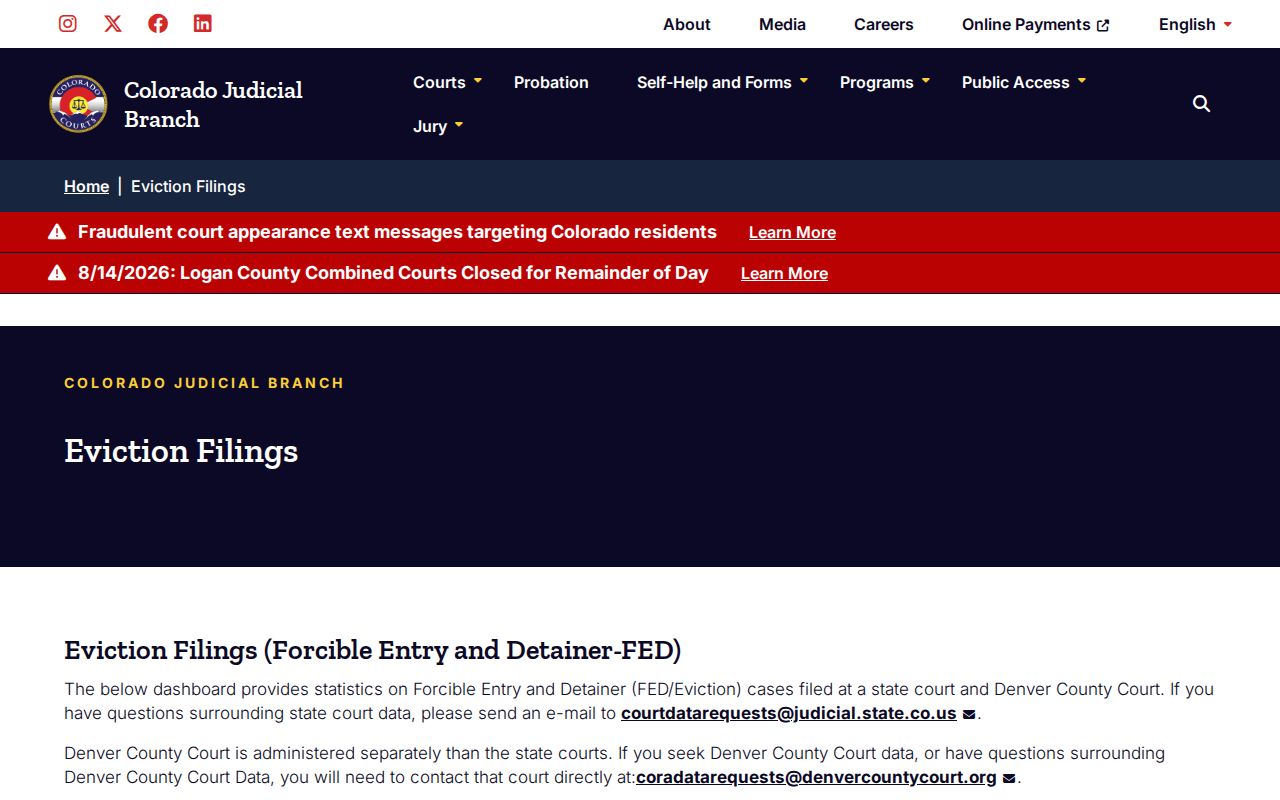
For big-picture civil court research, the dashboard helps. A single Summit County civil docket does not live there. Turn instead to the daily calendar, the statewide case index, or the clerk's record. Representation reports deserve the same caution. The Judicial Branch representation data page only describes aggregate court information.
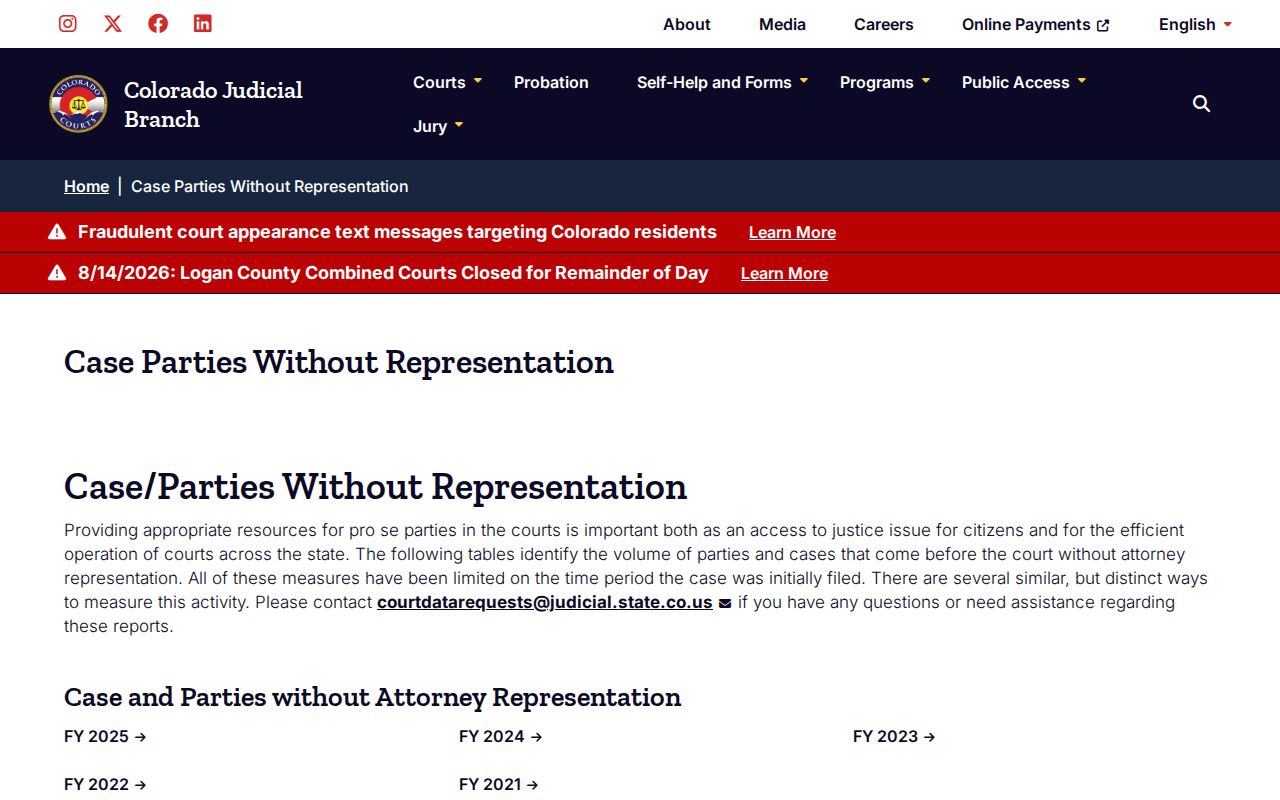
Neither tool tells you who filed what, or how a Summit County case ended. The Judicial Branch data and reports hub points the way when you need compiled information, and the annual statistical report archive tracks how statewide reporting has grown. Want statewide court context? The FY2024 statistical report offers that. It is not a trustworthy count of Summit County civil filings alone. Party-level docket details still come from the case-search and clerk channels.
Public Access to Civil Dockets
Colorado Chief Justice Directive 05-01 sets the main rules. It governs public access to Summit County civil dockets. Remote viewing can be narrower than what you see at the courthouse. A case open to the public may still hold a sealed exhibit, a redacted identifier, or a filing with no online image. Some material sits behind stricter walls. Juvenile records, protected domestic cases, adoptions, mental-health files, and certain probate papers may demand proof of role. They can also require government photo identification or a court order.
Key rules:
CJD 05-01 defines public court-record access and the records or fields limited from remote view.
CJD 06-01 governs copy, retrieval, research, scanning, and redaction charges.
Colorado Children's Code provisions make juvenile access depend on the record category and authorized requester.
A missing image never means a Summit County civil case is sealed. Just ask for the filing by name. When the governing rule allows access, the Summit County clerk handles ordinary inspection or quotes a copying fee.
Summit County Civil Portal Limits
Two different tools, two different jobs. CoCourts is the approved paid statewide electronic search. Colorado Courts E-Filing exists to submit documents. An e-filing account does not hand a public reader every Summit County civil filing. The free Summit County daily docket cuts even less ice. It only snapshots the calendar.
What about a CoCourts index entry with no image? Request the complaint, motion, order, or judgment straight from Summit Combined Courts. The Summit County clerk sits at 501 N. Park Avenue. The clerk answers the phone at 970-453-2272, takes email at 5thJDclerks@judicial.state.co.us, accepts faxes at 970-423-2150, and receives mail at P.O. Box 269, Breckenridge, CO 80424. Those channels keep court records reachable whenever a remote search falls short.