
How to Get Summit County Court Records
The Clerk of Court at Summit County Combined Courts holds the files. Those files cover both trial levels. District Court records cover felonies, major civil matters, domestic relations, probate, and juvenile cases. Mental health cases sit there too. County Court adds misdemeanors, traffic, small claims, and protection orders. Civil claims below the state limit land in County Court as well. Town cases live elsewhere. Breckenridge, Frisco, and the shared Silverthorne, Dillon, and Keystone municipal clerks keep those dockets. Read the Summit County court caption first. Then route the request to the right office.
The Colorado Record/Document Request Form is the direct online route. You can also go to the clerk window, mail P.O. Box 269, Breckenridge, CO 80424, or call 970-453-2272 for access help. The clerk email is 5thJDclerks@judicial.state.co.us. The main fax is 970-423-2150. CoCourts sells statewide index data, and the free Judicial Branch docket search lists daily settings. Neither one hands over a named filed paper. For that, you still need a clerk request for the document or certified copy.
- Confirm the Summit County court, case number, party name, and case class from the notice, ROA, or search result.
- Name the Summit County record product: ROA, filed document, certified or exemplified copy, judgment tool, or hearing transcript.
- Use the Summit County online form, counter, mail, phone, email, or authorized fax route that fits the request.
- Wait for the Summit County clerk to review access, locate the file, and quote the supported charge. Do not prepay.
- Pay after instruction and verify that the delivered Summit County record matches the case number and document title.
Four Summit County Court Record Products
People asking for Summit County court records often request a transcript. They really need something else. The clerk's request form separates four distinct products, and the choices are not interchangeable. The Summit County ROA is the Register of Action. It is a short chronological history of a case. A Summit County filed document is the real thing. It is the motion, order, judgment, or pleading that a docket entry points to. A certified copy is any single document the clerk has authenticated. A hearing transcript, finally, is the word-for-word account produced by a court reporter or transcriber.
| Product | What It Provides | Who Prepares It |
|---|---|---|
| Summit County Register of Action | Charges, sentences, minute orders, settings, and other dated case events | Summit County Combined Courts clerk |
| Summit County filed document | The selected pleading, order, judgment, or filing behind an ROA entry | Copy supplied from the Summit County clerk's case file |
| Summit County certified copy | An authenticated copy of a selected court document | Clerk of the Summit County court that holds the file |
| Summit County hearing transcript | A word-for-word account of a court proceeding | Summit County court reporter or transcriber |
Then there is the Summit County Transcript of Judgment. It sounds like a transcript but is not one. The clerk issues it to record or enforce a judgment. Nothing anyone said in court appears in it. Picking the wrong product on a Summit County records order means delay. Usually it means a second order too.
Types of Summit County Court Records
Records from both trial-court levels are covered by one request form. Both levels sit at the Summit County Justice Center. The form lists choices for criminal, civil, probate, and "other document" material. Checkboxes include a disposition or sentence order, protection order, order for judgment, Transcript of Judgment, satisfaction, probate paper, or an ROA. Asking for "the whole file" invites more staff review and copying. Tie the request to one dated docket entry instead.
- Summit County case histories, daily docket settings, and Registers of Action.
- Summit County complaints, petitions, answers, motions, briefs, notices, and service records.
- Summit County minute orders, signed rulings, disposition or sentence orders, and judgments.
- Summit County public civil, small-claims, criminal, traffic, probate, and protection-order material.
- Summit County judgment products, including an order for judgment, satisfaction, or Transcript of Judgment.
- Summit County exhibits that remain in the file and are not sealed, protected, returned, or otherwise withheld.
Access within a single Summit County case can be uneven. One ROA entry may show up. The document image behind it stays unavailable online. That gap does not mean the case is sealed. The better move is to name the Summit County filing by title and date. Send that detail in the clerk request.
Summit County Court Record Form Fields
Filling out the Summit County electronic form means giving your contact information and mailing address. Add enough case detail for the clerk to work with. You pick the court location and say which record you want. The form's sample case number, 2023AA123456, is just one shape among many. Summit County court records span several case classes. If you already have a Summit County case number, use it. A number beats a name for precision. Probate requests can include a date of death. Check the certification box for an authenticated copy.
The Judicial Branch public-records access guide spells out the split. Single Summit County case records go one route, compiled court data another, and administrative records a third.
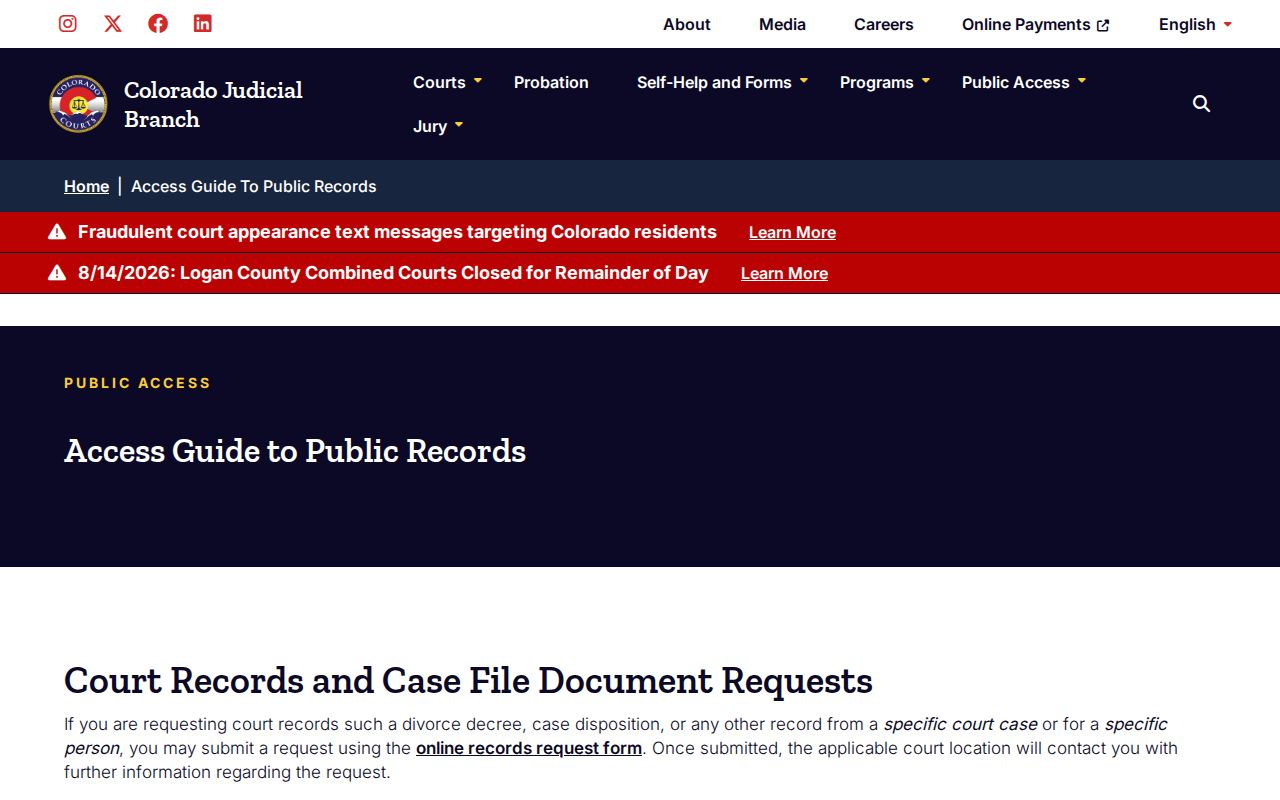
That split matters in practice. One Summit County case document belongs with the Summit County clerk. But a broad data extract does not travel through the ordinary form.
Once you submit, three business days is the stated response target, absent extenuating circumstances. Treat it as a goal, not a guarantee. A large, archived, or redaction-heavy Summit County court record can take longer than three days. The clerk may also come back first. It may ask for more detail, proof of authorization, or payment. Prefer paper? The Judicial Branch offers a printable Record/Document Request Form. It serves requesters who cannot use the electronic route.
What a Summit County Court Record Contains
A Summit County court record holds more than a line on the daily calendar. Think of the ROA as the table of contents. It indexes each event, while the individual papers carry the actual claims, responses, and signed rulings. Which fields you see depends on the court level and case class. Criminal records open to the public may show charge and disposition fields. Civil files lean on party-role labels, service events, motions, judgments, and post-judgment entries instead.
| Case Number | Summit County identifier tied to filing year, case class, and sequence; use the exact value shown by the court. |
|---|---|
| Court and Division | Summit County or District Court, assigned division or courtroom, and judicial officer when public. |
| Parties and Roles | Summit County plaintiff and defendant, petitioner and respondent, or State and defendant, plus public counsel entries. |
| Pleadings | Summit County complaints, petitions, answers, motions, responses, notices, and service-related filings. |
| Orders and Judgments | Summit County minute orders, signed rulings, disposition or sentence orders, judgments, and satisfactions. |
| Settings | Past and future Summit County dates, time, event type, courtroom, and the trail left by a reset or continuance. |
| Exhibits | Items accepted or lodged with the Summit County court, subject to retention and access limits. |
| Restriction Flags | Summit County sealing, suppression, protected content, or access controls when the public record may show them. |
Before ordering anything, run the Summit County case search to pin down the case number. Just remember that a search result is not a certified court record.
Archived Summit County Court Record Requests
Some older Summit County court files sit in storage away from the courthouse. A Summit County remote docket search may turn up nothing on an old case. Call the Summit County clerk instead. Give the clerk what you know: the party name, case number, case class, and the closest filing year. Ask whether the file still rests at the Justice Center. Ask whether it needs to be pulled from the archive. Retrieval costs whatever it actually costs, so no flat archive price exists to publish here.
Once the clerk finds the file, order only what you truly need. Naming the document and its docket date helps the clerk pull the right paper fast. The request form warns against sending money up front. That warning counts double when page counts, research time, redaction, or retrieval fees cannot be known in advance.
Note: A missing online image may reflect remote-access limits or storage location. It is not a finding that the Summit County court record is sealed.
Certified Copies and Fees
A plain copy just reproduces a public document. A certified or exemplified Summit County court record adds the clerk's formal authentication. Certification will not unlock protected material. It also will not turn an ROA into a filed order. Pick the named document, choose the certification option, and wait for the clerk's quote. The statewide charges match the official request form and CJD 06-01.
| Item | Amount | Operational Detail |
|---|---|---|
| Copy | $0.25 per page | Party or attorney maximum of $15 for their own case; no maximum for nonparties |
| Certified or exemplified copy | $20 per document | Applicable page-copy charges may also apply |
| Name search | $5 | Used when the case number is unknown |
| Transcript of Judgment | $25 | Judgment instrument, not a hearing transcript |
| Certificate of Satisfaction | $20 | Clerk certificate tied to a satisfied judgment |
| Off-site retrieval | Actual cost | Quoted after the archive location is checked |
| Research or redaction | $30 per hour | Quarter-hour increments after the first hour |
Summit Combined Courts Clerk
501 N. Park Avenue
Breckenridge, CO 80424
Mail: P.O. Box 269
970-453-2272
The building opens weekdays from 8:00 a.m. to 5:00 p.m., with one catch. The clerk closes from 4:00 to 5:00 p.m. on the first and third Thursday for a staff meeting. Call ahead before any time-sensitive trip.
Summit County Court Record or Transcript
Transcripts follow a different path. An ROA, an order, or a certified Summit County court record comes through the clerk route. Attorneys file transcript requests electronically. A self-represented party can email 5thJDclerks@judicial.state.co.us or fax 970-453-1134. A reporter or transcriber then reaches out about cost and timing.
Spell out the hearing date, case number, courtroom, and the part of the proceeding you need. Skip the "Transcript of Judgment" option if you want spoken testimony or argument. That $25 clerk product supports judgment recording or enforcement. A reporter transcript is a separate record. Summit proceedings have no set page rate or delivery time.
Summit County Court Record Quotes
Summit tells requesters not to prepay. That rule frees the clerk to tally page count, certification, retrieval, research, and redaction before any money moves. It also explains why the online form demands good contact details. A tight request with the case number, document title, and docket date gives the clerk a solid basis for the quote.
The official Summit Clerk of Court listing names the local clerk and the ADA contact.
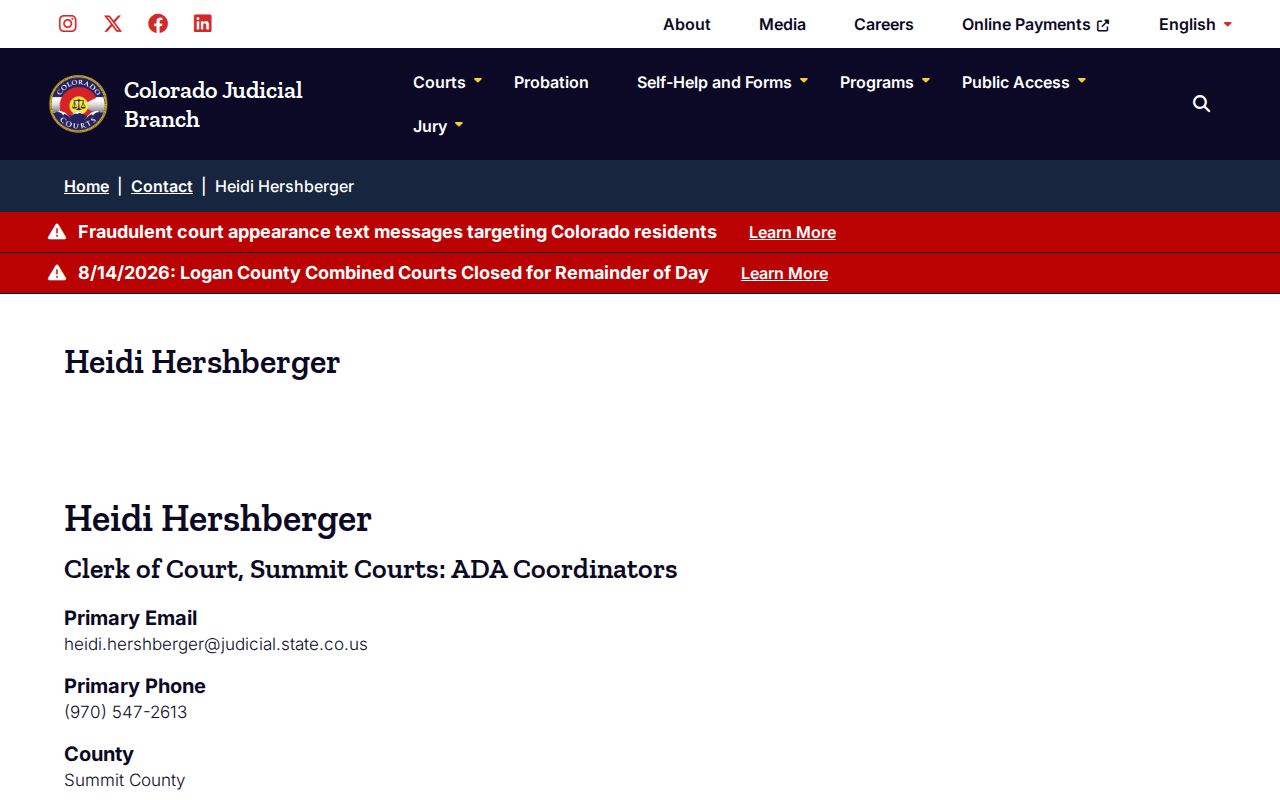
The listing points requesters to the public official who runs the unified County and District Court clerk operation. Contact that office directly for Summit County court docket questions.
Public Access and Sealed Records
Colorado court directives govern public access to Summit County court records. Statutes layer on extra rules for criminal-justice and juvenile material. Remote access is narrower than what a courthouse terminal offers. A sealed or suppressed case may not surface in a routine name search. Protected identifiers can also be redacted from a public filing. Juvenile, probate, and protected-material requests may demand U.S. government-issued photo ID. Proof of your role may be required too.
The current CJD 05-01 public-access policy page states the governing court-record rule in full.
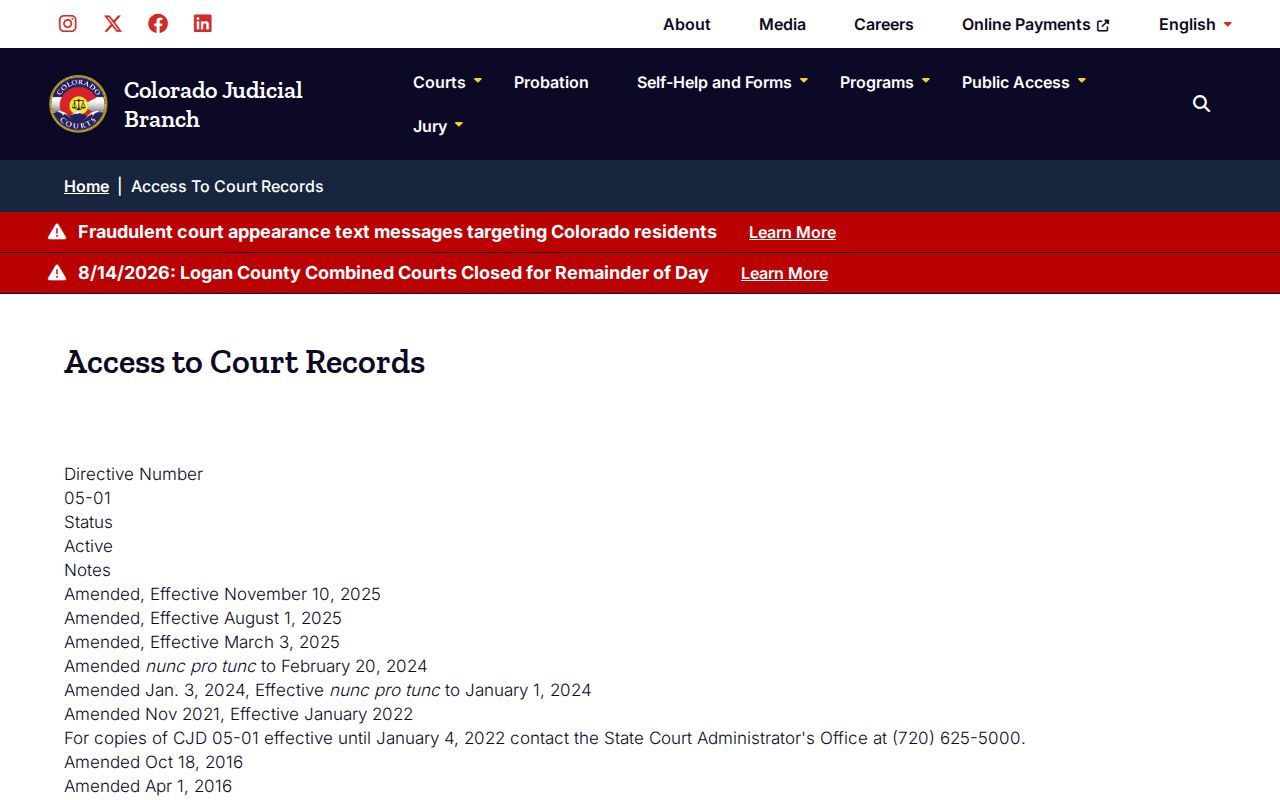
Check the policy page itself rather than an old summary. CJD 05-01 has been amended, so earlier write-ups may not match the current access framework.
Colorado access rules:
Chief Justice Directive 05-01 defines public access to court records and limits specified records and remote fields.
The current CJD 05-01 text controls Summit County access over an older summary or superseded version.
Colorado Criminal Justice Records Act, C.R.S. §§ 24-72-301 et seq. permits custodian procedures and lawful withholding.
Children's Code, C.R.S. §§ 19-1-301 et seq. restricts juvenile-record access by category and requester.
CJD 08-02 authorizes cost recovery for Summit County electronic court-record and e-filing systems operated through Colorado.
Certification never overrides a sealing order or a confidentiality rule. File the request with the court holding the case. Explain any claimed authority, then let the custodian decide what may be released.