
How to Search Criminal Dockets
Pull the case number and court name off a summons, bond paper, or notice first. Do not search anything without them. With those in hand, the Colorado Judicial daily docket shows a Summit County setting fast. It filters by date and location, sometimes by courtroom or division too. Remember the list is only a calendar snapshot. The complete Summit County criminal case record comes from CoCourts. A clerk-issued Register of Action works too.
No result does not mean no case. Try alternate spellings, a different court level, another filing year, or a municipal court. Remote access can also be restricted. The Summit County case search walks through the name and case-number routes in more detail.
- Confirm whether the Summit County caption names County Court, District Court, or a municipal court.
- Search the daily docket by date and Summit County location for a scheduled event.
- Match the exact Summit County case number, court level, caption, and event type.
- Use CoCourts or request an ROA for the chronological case history.
- Ask the Summit County clerk for a named order when an index entry has no public image.
Summit County Criminal Court Route
Criminal cases here run through two state courts. County Court takes misdemeanors and traffic matters, and it may open a felony complaint for advisement or preliminary processing. District Court then handles the felony through motions, plea or trial, sentencing, and disposition. Both sets of files sit with the Summit County Combined Courts clerk. It is one Justice Center.
That handoff leaves traces in the docket. A County Court felony complaint is a starting point, not a final resolution. Match the case number, the court line, and the newest event before deciding where a case stands. Town-code violations stay with Breckenridge, Frisco, or the shared Silverthorne, Dillon, and Keystone municipal clerk. The record may point elsewhere, though.
Criminal docket flow: County Court complaint and advisement › District Court filing › arraignment › pretrial proceedings › plea or trial › disposition and sentence.
What a Criminal Docket Shows
A criminal ROA is a chronological index of the case. Start with the header. It should say whether the case sits in County Court or District Court. It should also name the division. Then work through the charge block, court events, settings, resolution, and any later activity. Colorado's record form shows a general pattern like 2023AA123456. Copy the real Summit County case number instead of assuming a local code.
| Header | Summit County case number, court level, division, filing date, status, and judge when public. |
|---|---|
| Parties | State of Colorado and defendant role, with counsel where public. |
| Charges | Each count, offense description, statute, classification, and recorded result. |
| Bond | Release order, type, amount, conditions, or warrant event when public. |
| Events | Summit County complaint, advisement, counsel entry, motions, plea, verdict, sentence, or appeal. |
| Settings | Summit County date, time, courtroom, judicial officer, event type, and reset trail. |
| Documents | An entry description that may require a separate clerk request for the paper. |
Summit County Criminal Charge Blocks
Read each Summit County count separately. The offense label, statute, class, and disposition can vary from count to count. A complaint states an allegation, not a conviction. An arrest-related event does not settle the outcome either. The end of the sequence may show dismissal, a guilty plea, acquittal, trial conviction, deferred judgment, sentence, probation, appeal, or sealing.
Money fields deserve the same caution. Bond secures release or sets conditions while the case is pending. A fine can be part of the sentence, while restitution covers a loss the court ordered. A balance might reflect costs or a payment plan. Never swap these labels based on the amount alone.
- Advisement
- An early appearance at which allegations and rights are explained.
- Arraignment
- The stage at which a plea is entered.
- Disposition
- The recorded way a charge or case ended.
- Deferred judgment
- A resolution whose final effect depends on the order and stated conditions.
- Minute order
- A brief entry recording what the court did at a proceeding.
Stages on a Criminal Docket
Every Summit County criminal docket opens with the charging paper, usually a complaint. Early entries often include a summons or warrant, advisement, and a bond order. Counsel appears, and a first setting follows. A felony may then show a transfer or District Court information. Arraignment, motions, pretrial conferences, and trial notices follow. Misdemeanors often stay in County Court until resolved.
Resolution entries call for the order's actual language. A plea, dismissal, verdict, or deferred judgment may touch only some charges. Sentencing follows a conviction or a plea that supports judgment. Later entries can record probation review, restitution, an appeal, a sealing order, or payment of what is owed.
Docket process: Filing › Arraignment › Pretrial › Plea or Trial › Disposition › Sentencing.
Summit County Criminal Docket Resets
A new date does not erase the old line. The ROA typically keeps the first hearing. It then adds "continued," "reset," or a minute order with the new setting. Read the newest event first, then compare it with the latest signed notice. The same caption on two dates can simply be history, not two live hearings.
Need to confirm an imminent event? Call Summit County Combined Courts at 970-453-2272 with the case number ready. Courtrooms G, O, and R appear on the public virtual-court listing, but a livestream is observation only. It does not count as an appearance. Webex attendance takes advance permission from the court. Whatever the assigned Summit County court directs controls over an older web listing.
Which Court Holds Criminal Dockets
Two courts split the Summit County criminal docket. The Summit County Court side handles misdemeanors, state traffic matters, and felony complaints in their early stage. Once a felony moves past the preliminary stage, Summit County District Court takes the prosecution. The Summit County Clerk of Court serves both, working out of Summit County Combined Courts. So an address alone tells you nothing about which criminal docket to open. The case class and the court label on the file do that work for you.
Municipal courts sit apart from this state system. They handle town ordinances, municipal traffic tickets, and minor local offenses. Breckenridge Municipal Court runs as a court of record. Frisco keeps cases born from its own municipal authority. Silverthorne hosts a shared forum covering Silverthorne, Dillon, and Keystone. When a ticket or summons names one of these forums, take it to that municipal clerk. Skip the state docket.
Colorado also runs treatment and problem-solving court programs. Summit County posts no separate searchable specialty docket. Track that activity through the underlying criminal case number unless Summit County Combined Courts points you to a specific calendar. Treatment details may stay confidential.
| Forum | Criminal work | Custodian |
|---|---|---|
| Summit County Court | Misdemeanors and felony complaint stage | Summit Combined Courts clerk |
| Summit County District Court | Felony prosecution after the early stage | Summit Combined Courts clerk |
| Municipal court | Town-code and local minor offenses | The named municipal clerk |
Summit County Criminal Record Products
Name the product before you request anything from the Summit County clerk. A criminal ROA gives the short, dated history of the case. A Disposition/Sentence Order holds the court's written result. Certification adds the clerk's authentication. A transcript is the word-for-word record prepared by a reporter or transcriber. Asking for "the whole case" invites delay and extra cost. One item will do.
Use the Colorado Record/Document Request Form and pick the criminal document you need. Choices cover a Disposition/Sentence Order, Protection Order, Ticket, and Register of Action. The form warns that suppressed or protected material may require identification. Summit's clerk asks that you not send money up front. Staff review the request first and quote any charge.
The published schedule sets copies at $0.25 per page. Certification or exemplification runs $20 per document plus applicable pages. A $5 name search may apply if the case number is unknown. None of these fees turns an index entry into a certified finding. Only the clerk's authenticated record carries that weight.
Summit County Missing Criminal PDFs
A criminal event can be public. Its filed image may still block direct download. Colorado policy treats electronic index access, remote document access, and counter inspection as separate layers. The right move is to request the named complaint, order, or disposition from the clerk. One missing PDF does not mean the Summit County criminal docket is sealed.
The Judicial Branch public-access guide covers the official routes. It also sets the limits that govern Colorado court records.
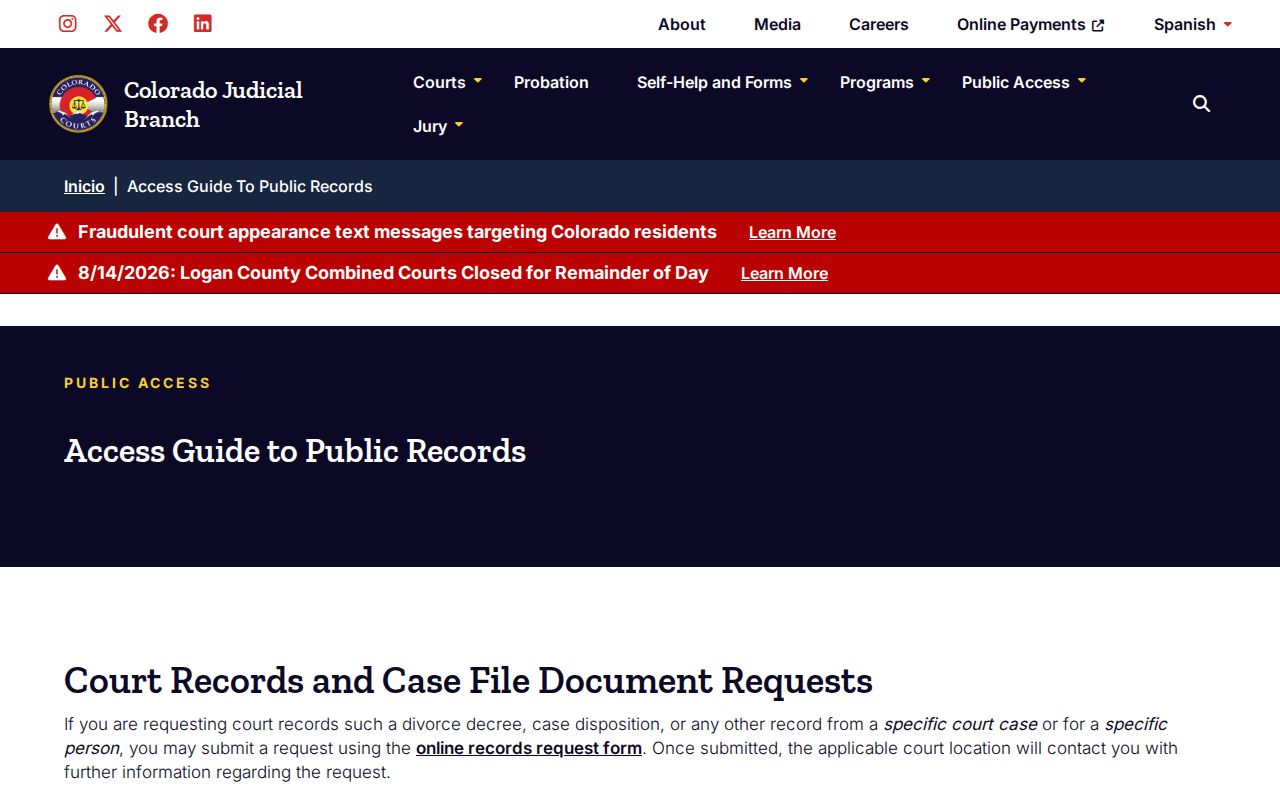
The guide backs a layered approach. Start with the docket, then ask the court that keeps the file for the document itself.
Public Access and Sealed Criminal Dockets
Chief Justice Directive 05-01 anchors Colorado's court-record access policy. It opens most records to the public. Named items and remote fields can still be excluded or limited. The Colorado Criminal Justice Records Act adds its own layer. It lets a custodian withhold or set procedures when a law, court rule, order, or public-interest test supports it. Juvenile records follow the Children's Code and never sit in ordinary public criminal dockets.
A sealed or suppressed matter may vanish from a name search or show only limited data. Knowing the case number does not lift the sealing order. The clerk cannot disclose beyond it. Victim details, minor identifiers, account numbers, and protected addresses can also be redacted. Authorized parties should state their role. Bring government photo identification when the request form calls for it.
Key rules:
CJD 05-01 sets access rules for Colorado case records and remote fields.
Colorado Criminal Justice Records Act governs access to criminal justice records and custodian decisions.
Colorado Children's Code limits access to juvenile records by statutory category.
Summit County Criminal Sealing Route
Colorado seals cases two ways. Some qualifying outcomes seal automatically; others need a petition. Eligibility, waiting periods, notice, objections, and the effect of an order all turn on the offense and its result. File through the court holding the case, using current Judicial Branch forms. Dismissal language alone is not enough to assume anything.
The official Seal My Case resource posts the current forms and routing.
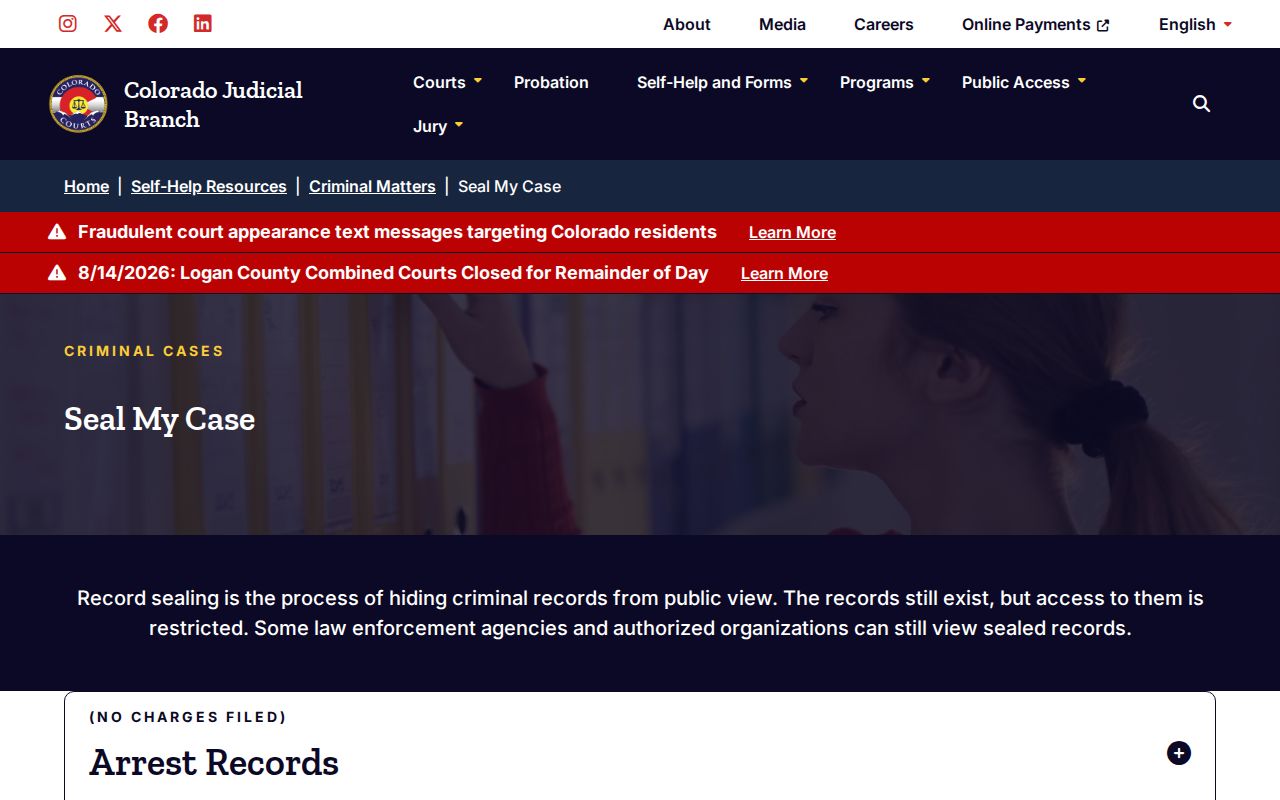
Match that resource against the actual Summit County criminal case outcome first. Only then decide whether to file.
Summit County Criminal Docket Limits
Remote results can omit sealed, suppressed, juvenile, and other protected records. Probate and domestic files carry their own limits. A public criminal docket can still hold protected documents inside it. A no-result page may trace back to spelling, filing year, court level, a municipal split, or lawful suppression. Treat it as a dead end. It is not a claim about any person or case.
The Colorado Courts E-Filing information describes the filing platform. That platform receives submissions into the state system.
E-filing access and public docket access are different permissions. A filing platform exists, but that does not make every submitted paper remotely public.
Summit County Municipal Criminal Cases
A docket search that stops at Summit Combined Courts will miss the town cases. Breckenridge Municipal Court meets on a published twice-monthly schedule and handles town matters there. Frisco Municipal Court covers municipal traffic, minor criminal, and animal-control cases. Silverthorne, Dillon, and Keystone share one municipal court. Check the jurisdiction printed on the citation before calling. Every municipal clerk keeps its own records.
One clue sorts the two systems fast. If a citation names the Summit County Justice Center, it belongs to the state route. The incident may have happened inside a town. A local ordinance caption, though, points to the municipal court. When the forum is unclear, read the top and middle of the ticket. Then contact the clerk named on it. Both courts may serve the same town. Sending a municipal record request to the Combined Courts clerk still slows things down.
Summit County Criminal Clerk Access
The Summit Combined Courts clerk takes record requests several ways. You can use the electronic form, stop at the public counter, or send mail to P.O. Box 269, Breckenridge, CO 80424. Authorized email and fax routes work too. Need help by phone? Call 970-453-2272. For in-person access, go to 501 N. Park Avenue during published weekday hours, keeping in mind the counter closes from 4:00 to 5:00 p.m. on the first and third Thursday of each month.
Older files may sit off site, so retrieving them costs actual charges. Staff work past the first free hour, including redaction time, is billed. The form says you should normally get a response within three business days. Circumstances can slow things down. That timing is no promise for a large, archived, or protected file, which can take longer. Ask for the exact ROA or order you need.
Summit Combined Courts
501 N. Park Avenue
Breckenridge, CO 80424
970-453-2272
5thJDclerks@judicial.state.co.us